






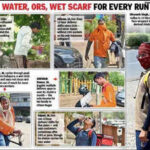


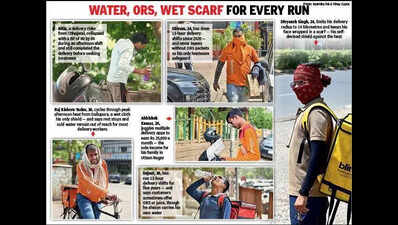
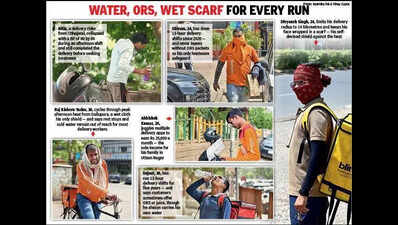
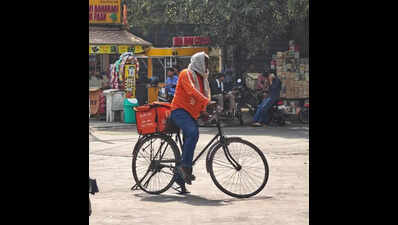
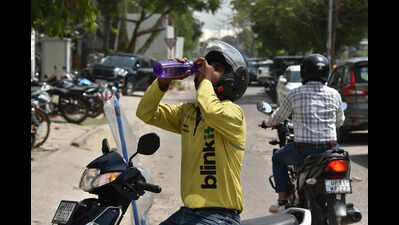
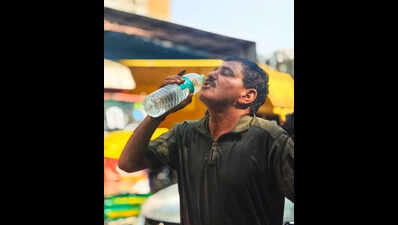
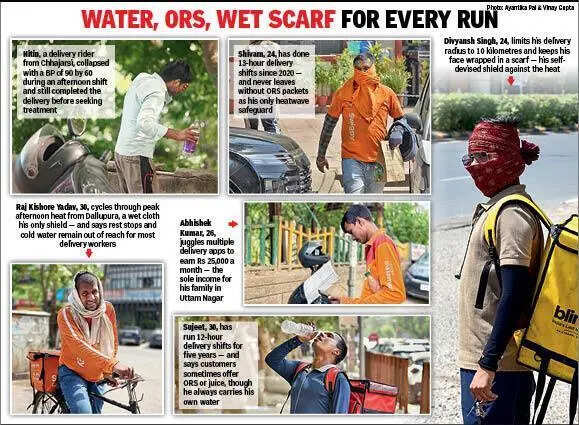
At 2.30pm, on a scorching Friday afternoon when the temperature touched 44°C, Abhishek Kumar (26) lugged grocery bags up five flights of stairs at a housing society in Noida Sector 71. He barely had time to wipe his face with his soaked-through t-shirt and drink water when another order flashed on his phone — in Mayur Vihar, nearly an hour away.“My phone, the bike seat, my helmet — everything feels like it’s on fire. By afternoon, even touching the bike handles becomes difficult,” he says. But taking breaks is not an option. “If we stop, orders pile up, ratings get affected and earnings fall. So we keep moving.”Abhishek earns around Rs 25,000 a month juggling food delivery apps and porter services to support his ageing parents in Delhi’s Uttam Nagar.For him and thousands of gig workers keeping households running across NCR, summer is no longer just an uncomfortable season. It has become a daily endurance battle fought on burning roads, with little access to shade, drinking water or rest.“We travel 60-70km daily in this weather. Helmets feel like ovens; the hot wind continuously hitting your face makes you dizzy,” Abhishek says. “People think this is easy work because we are just riding bikes. But by evening, our bodies completely give up.”Many spend up to 12 hours outdoors every day, resting under flyovers, petrol pumps or metro stations — anywhere they can find shade — between orders. Dedicated cooling zones or resting areas are almost non-existent.Gig workers say even the dark stores and waiting hubs operated by quick-commerce companies, where they go between deliveries, lack proper ventilation, cooling facilities and, sometimes, even clean drinking water.“The store is insulated, so once heat enters, it just stays trapped inside. It is extremely suffocating after a point,” says a delivery worker stationed at a dark store in Noida. “Many places don’t have air-conditioning. Some have fans or coolers, but they don’t help when dozens of workers are moving in and out.”“The stores are stifling. The roads are even worse,” says a delivery worker waiting outside a grocery hub in Noida. “We can’t rest for too long anyway because delivery alerts keep coming. Resting means losing money.”“Most of the time we just stand under trees,” says Raj Kishore Yadav (30), who lives in Dallupura near Vasundhara Enclave.Raj has been delivering parcels on a bicycle for two years. He works from noon to 8pm every day, cycling several kilometres for each order.He ties a white cloth around his head to protect himself from the sun. But it heats up within minutes, he says. “I keep pouring water on it all day, that’s the only way I can keep going,” he says.“The heat is so intense that sometimes even our phones stop working,” says Durgesh, who works for Zepto. “The screen hangs, apps freeze, and the battery drains quickly. If the phone stops, our work stops.”Truck drivers supplying goods to quick-commerce warehouses are no better off. Chaudhary Kushal Pal Singh (40) transports products between warehouses and Zepto dark stores in Faridabad. “We practically live inside the truck during shifts. The cabin becomes extremely hot in the afternoons and there are hardly any facilities at dark stores for drivers,” he says.“Nobody sees the hours we spend waiting in this heat during loading and unloading,” Chaudhary adds.Zepto delivery executive Avinash (27), who has been working with the platform for two months, says, “Sometimes we only get 15 minutes to rest. If stores had proper air-conditioning facilities, it would make a huge difference. The heat is too intense for coolers alone.”Road congestion further worsens the situation, he adds, because delivery targets continue as usual. “We hope orders keep coming so earnings continue, but travelling through heavy traffic in this heat becomes mentally and physically exhausting,” he says.“We do not even have access to proper washrooms,” says Maya Rathore, who works with an app-based beauty and salon service company. “By the end of the day, my clothes are completely soaked in sweat. I have got rashes on my body, my face has got sunburnt. For the last two days, I have also been struggling with a migraine.”Noida additional labour commissioner Suyash Pandey says ORS distribution and awareness programmes are conducted at labour chowks. “Schemes related to welfare and health support for gig workers are being planned,” he says.Though gig workers were included in discussions surrounding India’s new labour codes — which promised them social security benefits and welfare protections — many say little has changed on the ground.Most continue to depend entirely on app-based incentives without assured health support, paid leave or emergency medical assistance.Swiggy delivery worker Chandan (38) says gig workers often feel invisible. “Govt hardly listens to people like us,” he says. “Customers notice the delivery arriving on time, but they do not see the conditions in which we work.”Chandan says food delivery workers have nowhere indoors to rest between orders. “Whether it is extreme rain, cold or heat, we are always outside. There is a limit to how much a person can take, but we go on because EMIs, loans and household expenses never stop,” he says.Nitin, from Chhajarsi in Noida, says he had to go to the emergency room recently. He had started his shift around 11pm. “Around 2pm, everything started going dark. I managed to park and splash water on my face.”Doctors at the district hospital in Sector 39 found his blood pressure had dropped. They gave him ORS and medicine. “But I completed the delivery first, before going to the hospital,” Nitin says. “You can’t leave orders midway.”A senior doctor at the Noida district hospital says there has been a sharp rise in dehydration, heat exhaustion and dizziness cases over the past two weeks, especially among delivery workers, e-rickshaw drivers and people riding two-wheelers for long hours in the sun.
Gig workers gfx
“Gig workers remain exposed to direct heat for 8-10 hours daily. They often come in with severe weakness, headaches, low blood pressure and muscle cramps. Riding bikes in temperatures above 44 degrees Celsius significantly increases the risk of heatstroke,” the doctor said.Dr Anurag Aggarwal, director and HOD of emergency medicine and trauma at Fortis Hospital, Noida, says, “Gig workers are particularly vulnerable to heatstroke due to outdoor exposure. Continuous physical activity, dehydration, skipped meals, inadequate rest breaks, and prolonged use of helmets further increase the risk by trapping body heat.”Aggarwal says lots of workers tend to ignore symptoms to avoid missing work.“Heatstroke, however, is preventable if warning signs such as dizziness, weakness, muscle cramps or headache are recognised early. Once body temperature rises significantly and confusion develops, it becomes a medical emergency with risk of brain, kidney and multi-organ damage,” he says, adding, “Early treatment can save lives.”Zomato delivery partner Sangam, however, says the pressure to complete deliveries leaves little space to think about health.The 34-year-old, who has been working with the platform since 2018, says, “Sometimes it feels like your entire body is burning, but there is no real support system for workers. Everything depends on the number of orders, distance covered and incentives. If we stop working, earnings stop immediately. The heat may be immense, but household responsibilities are bigger.”