










Is it that time of the month? No issues. Pop a pill and get to work with a hot water bag! It sounds casual, almost harmless. But behind this everyday remark lies a deeper reality, one that millions of women silently go through every month.Modern work life is designed around a predictable, almost mechanical rhythm, but a woman’s body doesn’t follow the clock.A typical day for a man begins with waking up, moving through structured hours of productivity, peaking somewhere in the middle, and gradually winding down before sleep. The cycle repeats, day after day, with little room for deviation.But for women, the body does not always comply with this uniform pattern.Instead, it operates on a hormonal cycle that fluctuates across the month with energy levels rising and falling. Physical strength and emotional resilience ebb and flow. And yet, the expectation remains unchanged.Show up, perform, deliver. There is no pause button!Fatigue, mood shifts, and slight discomfort during menstruation are often considered natural. But intense, debilitating pain? That is not supposed to be “so normal.”And yet, it has become so common that it is often dismissed. Still, the response society expects is remarkably simple. Pretend nothing is happening!
What is menstruation?
Menstruation is a biological process in which the inner lining of the uterus sheds when an egg released during ovulation is not fertilised. This leads to the discharge of blood and tissue through the cervix and vagina, typically at monthly intervals.The first menstrual cycle, known as menarche, usually occurs between the ages of 8 and 15. On average, cycles repeat every 28 days, though variations are common.For some women, menstruation is not just a few days of discomfort, but also conditions like PCOD (Polycystic Ovarian Disease) or PCOS (Polycystic Ovary Syndrome) can lead to severe cramps, irregular cycles, prolonged bleeding, and hormonal imbalances.As Sneha Srivastava noted, “Every woman’s body is different. While some may experience minimal discomfort, others go through intense pain, nausea, and fatigue.” On a personal note, she added, “I have experienced significant discomfort due to PCOS. My periods can last for more than three weeks… managing this while working can be extremely challenging.”Tithi Pramanik from Odisha echoes the reality saying, “I have PCOD and experience severe cramps during my periods.” Yet workplaces rarely accommodate this spectrum of experience.
The menstrual leave debate in India
Most working women already know the unspoken rules.You go to work despite cramps that make it difficult to sit upright. You continue meetings through waves of nausea. You push through fatigue that clouds your concentration.Because acknowledging the pain feels risky.Ask for leave, and you may be seen as unreliable. Take time off, and you might miss opportunities. Speak openly about menstrual symptoms, and you risk being labelled “difficult.” So the safer option becomes silence.The idea of menstrual leave, time off granted to women during their periods has increasingly entered discussions around workplace rights, gender equality, and employee welfare.But India still does not have a nationwide law mandating menstrual leave.On March 13, the Supreme Court of India declined to entertain a public interest litigation seeking a uniform policy for menstrual leave across workplaces and educational institutions.
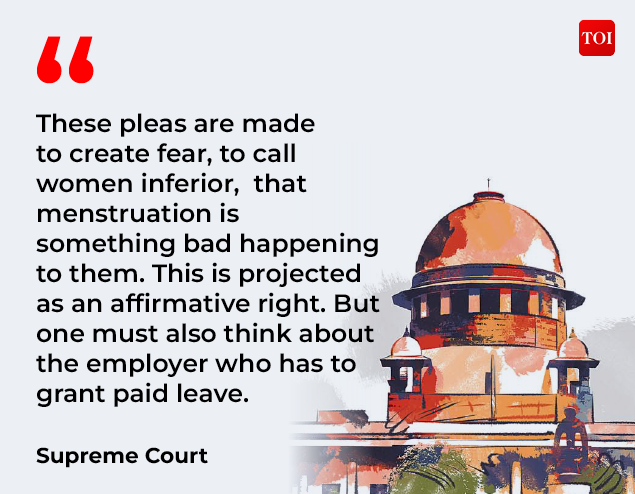
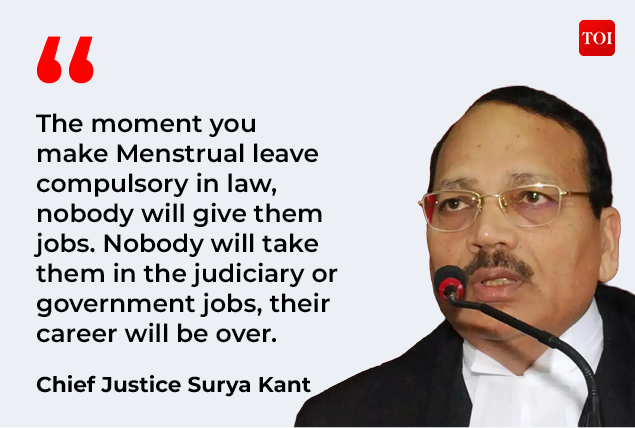
The court did not dismiss the issue outright but raised concerns about potential unintended consequences.The bench observed that making menstrual leave compulsory could discourage employers from hiring women. As Chief Justice Surya Kant noted during the hearing, “Voluntarily given is excellent. The moment you make it compulsory in law, nobody will give them jobs.”The court also warned that such a policy might reinforce stereotypes, portraying women as less productive or less reliable.Another point raised was that such decisions fall within the domain of policymakers, not the judiciary. The court suggested that the government should examine the issue after consulting stakeholders.
Will such a policy make employers hesitant?
For some, the solution may not lie in a strict leave policy.Raveena Newatia, a communications manager from Gurugram, said, “There might be a widespread belief that this would affect work so employers might,” acknowledging the hesitation that often surrounds such policies.“Although on the basis of right judgements and awareness, this could be changed in the longer run,” she added. Recalling her own experience and discomfort, Raveena said, “I have faced discomfort working and sitting on a chair in the office, and not being able to lay my back on a hot water bag even when desperately needed.”“I still believe that Work from Home norms or mobility flexibilities could be considered by the Supreme court in issuing some mid-solution law so that even the work doesn’t compromise and the females also don’t have to suffer at least physically,” she added.Ranjit, a Delhi-based entrepreneur, suggests flexibility saying, “I do not fully agree with the Supreme Court’s decision. Companies should at least be made to offer options like work from home and flexible working hours.”Ajit, a college professor from Gujarat, questions the logic of making such support optional. “How can a legal right be optional? Does that make sense? Women should have a choice whether to take the leave or work.”“Discrimination comes in all forms and sizes in society. Some employers might hesitate to hire women, at least initially, but I believe it’d quickly become clearer to them that better employee care translates into better output,” he added.Further addressing concerns that such policies might discourage employers from hiring women, Biswarupa Das, a PhD scholar in HR studies said, “honestly, in a time when organisations are implementing measures towards sustainable workplaces and acknowledging diverse needs, this shouldn’t even be a question.”“The focus should shift from seeing this as a ‘cost’ to responding with empathy and understanding. Women already take leave when the pain becomes physically and mentally overwhelming, it was just not always acknowledged openly.”“I don’t believe employers will hesitate, because an employee’s calibre cannot be judged on the days she is struggling with something she hasn’t chosen, it’s simply a part of biology,” she added.Not everyone is convinced that menstrual leave as a labelled policy is the right approach.Pankaj Jha, senior manager at an insurance firm said, “I think the idea of menstrual leave sounds progressive on the surface, but it’s worth asking why it hasn’t been widely adopted in developed countries like the US, UK, or Germany.”He points to a deeper issue: privacy. He said, “There is still significant stigma around menstruation, especially in smaller towns and cities. In such an environment, formally labeling a leave as “menstrual leave” could unintentionally expose women to judgment or ridicule.”“I’ve personally observed situations where women taking such leave became the subject of insensitive remarks by male colleagues behind their backs,” he added.Jha also noted that there are practical challenges in the implementation of such laws. “How do you define eligibility? What about women who have reached menopause, or those who experience only mild discomfort?” he said.He suggested a more nuanced approach by integrating menstrual leave within existing sick leave policies rather than creating a separate category.“Instead of introducing a separate, labeled category, I believe a more inclusive and respectful approach would be to incorporate it within existing sick leave policies, give women a couple of extra sick leaves per month,” he added.But on the ground, the reality is different. For many women, the debate is not theoretical, It is physical!As Tithi Pramanik said, “In my previous company, my manager said he would not hire women because of these issues.”“That’s why I feel making menstrual leave mandatory could increase bias and discourage employers from hiring women,” she added.While, Sneha Srivastava argued that leaving menstrual leave optional often defeats its purpose. “When something is optional, many women hesitate to avail it, often fearing judgment or being perceived as less committed at work,” she said.
A medical perspective: Do women really need leave?
Adding another layer to the debate, obstetrician and gynaecologist Nimmi Rastogi offers a clinical viewpoint.“Menstruation is a normal biological process. It is not a disease. It is not even a period of incapacitation. It is simply a reflection of how a woman’s physiology works,” Dr Nimmi said.While acknowledging that some women experience severe symptoms, she cautions against generalising, saying “It is true that some women experience PMS, pain, dysmenorrhea, clotting or heavy bleeding, but this is not the case for everyone. So, I don’t think it is a good idea to mandate menstrual leave.”Her advice is counterintuitive to many: stay active!“Medically, staying active actually helps ease most symptoms. We usually encourage patients to remain active and not refrain from work, school or studies. Even simple movements like walking can reduce pain,” she said. “If you lie down or remain sedentary during periods, it can be counterproductive for your health,” she added.For her, work itself can help. “Working is a good distraction. Symptoms like mood swings, PMS and irritability can be relieved through physical activity and engagement,” she said.
What most men think?
Iqbal Singh said, “Leave must be there because I have seen my wife bearing lots of pain and cramps. The story is different for every girl, but also seen some people are not cooperating towards it, when women really need a policy decision like this.”Hadi Khan echoes the same sentiment and said, “I’ll be honest, I do think menstrual leave is necessary. For women, periods aren’t just a minor inconvenience. They can be physically draining, sometimes even debilitating.”Yet, he also acknowledges the dilemma saying, “Yes, I do think that’s a real possibility that employers might hesitate to hire women if such a policy is enforced.”“Even if it’s not openly admitted, some employers might quietly factor it into their hiring decisions. In competitive or cost-sensitive industries, there’s often a tendency to view anything that could affect productivity or increase compliance requirements as a drawback,” he added.Shubhanshu Dwivedi frames it more sharply saying, “Menstrual leave is a basic workplace support measure and not a privilege.”“The argument that such a policy may discourage hiring rests on accepting discrimination as a given. That is a slippery position,” he added.
The cultural silence and stigma
The challenge is not just policy, it is also cultural. But how can one go and seek menstrual leave when we don’t even speak about menstruation in the open!In many parts of India, menstruation remains a taboo subject. Women are often discouraged from speaking about it openly. In some households, restrictions still exist.Pari (name changed) from Assam describes her reality, “On the three days of my period, I sit and sleep on the floor. I eat on a separate plate as I am not allowed to enter the kitchen or touch any utensil or other furniture. I do not touch any male member be it my father, brother or husband. These customs have been followed for a very long time in my household and me, my mother and sister have applied the same in our lives.”Yash Sonkar further points to a lack of awareness, saying, “Menstruation isn’t even properly explained in our school curriculum… teachers skip the chapters at times.”Even basic products like sanitary napkins are often wrapped discreetly, reinforcing the idea that menstruation is something to hide.Interestingly, menstruation was not always viewed this way.In ancient India, it was often associated with fertility, renewal, and the cycles of nature. Some traditions even treated it as a time for rest and reflection.Over time, however, colonial influences, patriarchal interpretations, and cultural shifts transformed this perception into one of impurity and shame.What was once a period of care became a period of silence.
Global and Indian policy landscape
Globally, countries like Japan, Spain, South Korea, and Indonesia have menstrual leave policies.But even there, challenges remain.As Pankaj Jha points out, “Even in places like Japan, menstrual leave is often unpaid, which raises questions about how effective or empowering it truly is.” In India, efforts are scattered. Some states and companies have introduced policies, but there is no unified national framework.
The productivity paradox
There is a growing body of research suggesting that workplaces with better gender inclusion perform better overall. Companies with more diverse leadership often show stronger financial and governance outcomes.In simple terms, when women are supported, they deliver. So the real question is not whether menstrual leave reduces productivity.It is whether ignoring biological realities is sustainable in the long run.
Rethinking the workplace?
Imagine a different system. A workplace that acknowledges biological differences instead of ignoring them. One where women can align tasks with their natural energy cycles, high-focus work during peak phases, lighter tasks during physically demanding days.A system where taking care of health is not seen as a weakness, but as part of being human. Biswarupa captures this sentiment saying, “Menstrual leave is absolutely necessary. Such leaves would be a meaningful step towards acknowledging what all the women go through silently.” The debate on menstrual leave is not just about policy. It is about recognition. Recognition that biology is not uniform.Recognition that equality does not always mean sameness. Recognition that support systems need to reflect real human experiences.For now, the Supreme Court of India has left the matter to policymakers. But the conversation is far from over.Because every month, across offices, classrooms, factories, and homes, millions of women continue to work through pain, quietly, invisibly, and without acknowledgment. And perhaps the real question is not whether menstrual leave should exist.It is why, even today, it still needs to be debated!