








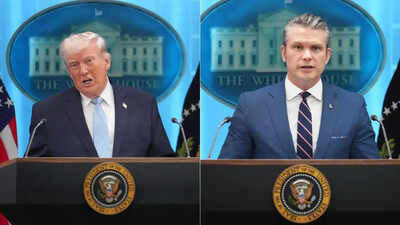
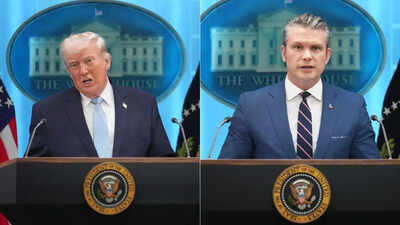
US Defence Secretary Pete Hegseth on Monday linked the Easter Sunday rescue of a US airman shot down over Iran to the Resurrection of Jesus Christ.Speaking at the same news conference, President Donald Trump said that God supports the Israeli-US war against Iran, which has resulted in thousands of deaths, including civilians. “Because God is good,” he said, “and God wants to see people taken care of.”Mirroring his previous statement, the President also added, “God doesn’t like what’s happening. I don’t like what’s happening. Everyone says I enjoy it. I don’t enjoy this.” He also said, “I don’t like seeing people get killed.”Describing the rescue, Hegseth said the F-15E fighter jet was “shot down on a Friday — Good Friday,” the day Christians observe the crucifixion of Jesus.After ejecting over Iran, the airman hid “in a cave, a crevice, all of Saturday,” he said.The rescue took place early on Easter Sunday. The pilot was “flown out of Iran as the sun was rising on Easter Sunday,” Hegseth said. “A pilot reborn, all home and accounted for, a nation rejoicing… God is good.”Hegseth also said the airman sent a message to rescuers after the crash, saying, “God is good.” He added that in “that moment of isolation and danger,” the airman’s “faith and fighting spirit shone through.”Hegseth has previously referred to Christian faith in public remarks about the war. Earlier, he asked Americans to pray for victory in the Middle East “in the name of Jesus Christ.”Some Christian leaders, including Pope Leo XIV, have disagreed with suggestions that the war has religious backing. The pope has called for an end to the conflict and said that Christianity should not be used to justify violence. In a recent homily, he said the faith has at times been “distorted by a desire for domination, entirely foreign to the way of Jesus Christ.”Hegseth has also referred to the Crusades, the medieval conflicts between Christian and Muslim groups. A tattoo on his arm reads “Deus vult,” or “God wills it,” a phrase linked to those wars. In his 2020 book American Crusade, he described the Crusades as “bloody” but said they were justified in their historical context.