








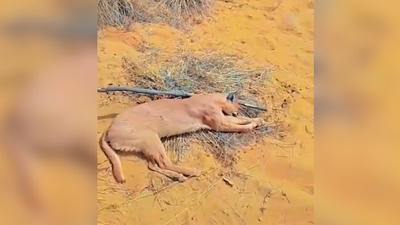
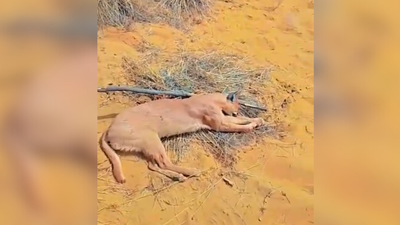
JAISALMER: An endangered Caracal was allegedly hunted in the border area of Shahgarh in Rajasthan’s Jaisalmer district, and its carcass was burnt in an attempt to destroy evidence.The Forest Department recovered the charred remains of the animal during a search operation on Monday. A video showing the dead caracal had gone viral on social media on Sunday.Following the circulation of the video, the Forest Department launched an operation in coordination with Shahgarh police. During the investigation, three suspects were identified. One accused has been detained and the tractor allegedly used in the incident has been seized, while a search is under way to locate the remaining suspects. The carcass has been sent for post-mortem examination.The Forest Department has also called a team from the Wildlife Institute of India (WII), which is currently in the Sam area of Jaisalmer, to collect biological samples for genetic analysis. The samples will be extracted from the carcass of the dead caracal and will help develop a genetic database for this rare and endangered species, which may assist future research and conservation efforts.Jodhpur Chief Conservator of Forests (CCF) Anoop K. R. said the Forest Department conducted a raid at the site in the Shahgarh border region where the animal had been killed and whose video had circulated widely on social media.He said those involved in the crime attempted to destroy evidence by burning the carcass. Despite this, a team of expert veterinarians managed to extract biological samples from the charred remains. These samples will be sent to the Wildlife Institute of India in Dehradun for genetic analysis to help establish the identity of the killed animal.The analysis is also expected to provide insights into the genetic characteristics of the westernmost population of caracals in India, which remains largely unknown.Jaisalmer District Forest Officer (DFO) Kumar Shubham said the Forest Department, in coordination with Shahgarh police, identified three individuals seen in the viral video. One accused has been detained while the search for the other two continues.He added that viscera samples will be sent to the Wildlife Institute of India in Dehradun for scientific study. The department has contacted Dr Suthirto Dutta, senior scientist at WII and coordinator of the Great Indian Bustard Breeding Centre, who is currently in Jaisalmer, to assist in collecting the required samples.Kumar Shubham said the caracal is a rare and poorly studied species in India. Genetic analysis of biological samples will help create a genetic database for the species, which will support research and conservation efforts in the future.He noted that samples collected from the collared caracal represent some of the first from this region. As genetic profiles of more individuals are added to the repository, researchers will be able to study whether the Thar Desert population is genetically distinct, its genetic diversity, possible gene flow with other populations, and whether the species faces risks such as inbreeding or population fragmentation.He said that if sufficient samples are collected, genetics-based mark-recapture techniques could also be used to estimate the population size of the species.Developing a genetic profile will also help scientists identify caracals in the future from field samples such as scats or prey remains, and assist in investigations related to poaching or illegal wildlife trade.