








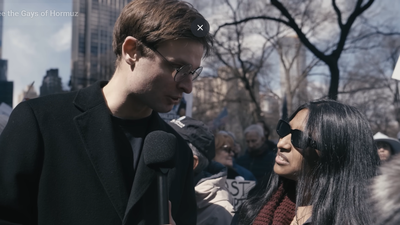
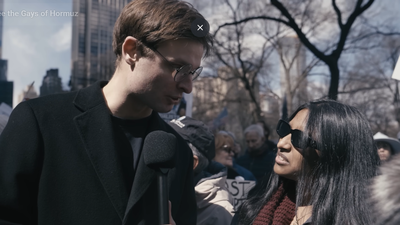
The “No Kings” protests swept across the United States and parts of Western Europe on March 29, 2026, drawing thousands opposed to President Trump’s foreign policy, particularly the escalating tensions with Iran over the Strait of Hormuz. Organisers framed it as a movement for democracy, peace, and civil rights. It was all of those things, presumably, to someone. To street interviewer Lionel, known online as No Cap On God (@Nocapongod_), it was also an opportunity to ask some very simple questions. The answers that followed have since been shared by everyone from regular Twitter users to Ted Cruz.
From ‘gays of Hormuz ’ to ‘Iran supports LGBT’ claims: Wild comments go viral
Lionel’s opening gambit was, on the surface, absurd. Approaching a protester, he asked whether it was “a little bit homophobic” that global attention was focused on the Strait of Hormuz rather than the Gays of Hormuz.The protester agreed immediately. Completely. Without hesitation.“Yes, I agree. Yes, for sure,” she said, before launching into a thoughtful explanation of how “historically, gays have always been very discriminated against, which is wrong on so many levels. Even in war.”To be clear: The Gays of Hormuz do not exist. The Strait of Hormuz is a real and critical waterway through which roughly 20% of the world’s oil supply passes. It has been at the center of US-Iran tensions for months. There are no Gays of Hormuz. There is no injustice being committed against them. They are a pun.The protester did not appear to consider this possibility. Instead, she called for government reform and public education to address the crisis, the fictional one, with the same conviction one might bring to an actual geopolitical issue.Lionel, impressively, kept a straight face throughout. Whether the same can be said for the Strait of Hormuz is less certain.If the first protester set the tone, a self-described straight male ally raised the stakes considerably.Upon learning of the plight of the Gays of Hormuz, again, not real, he declared himself constitutionally and morally bound to act.“I’m a straight guy. I’m an ally, man,” he said, with the gravity of someone announcing their intention to run for office. “They’re going for the Straits of Hormuz but they’re not willing to protect the Gays of Hormuz. That’s not cool.”At some point during the interview, a small group began chanting: “Free the Gays of Hormuz! The gays will refuse to let themselves be left behind!”This chant was apparently spontaneous. It was apparently sincere. And it apparently did not occur to anyone involved to ask where, exactly, the Gays of Hormuz were located, what they needed freeing from, or whether they had been consulted on the matter.The ally also offered, unprompted, that the area could “turn into Fire Island for sure,” a suggestion that implies a level of urban planning optimism rarely seen in Middle East foreign policy discussions.
Iran: A feminist paradise, according to people at an anti-war protest
Lionel then turned his attention to a man waving an Iranian flag and asked what he thought of America’s complicated relationship with Tehran.“I think America hates them because Iran is so feminist,” the man explained.A companion agreed enthusiastically, adding that there was “no better place to be a woman than Iran compared to here,” here being the United States, a country where women can drive, vote, appear in public without a mandatory dress code, and pursue legal recourse without requiring a male guardian’s permission.Iran, by contrast, currently ranks among the most restrictive nations on Earth for women’s rights. The country has seen years of protest, often brutally suppressed, by Iranian women demanding basic freedoms. The “Woman, Life, Freedom” movement, which emerged following the death of Mahsa Amini in 2022, remains one of the most significant feminist uprisings of the modern era. None of this appeared to be information the protesters had encountered.The conversation did not stop there.When Lionel asked about LGBT rights in Iran, a nearby protester offered that Ayatollah Khamenei was “very pro-LGBT” and that there were even internal discussions about the next Supreme Leader being “a gay guy.”For context: homosexuality is illegal in Iran and punishable by death. The Islamic Republic has executed individuals for same-sex relations. The Ayatollah has not, to anyone’s knowledge, expressed pro-LGBT sentiments. Nobody pushed back. Nobody fact-checked. Lionel simply moved on to the next question.
The guillotine segment (the nonviolent one)
Perhaps the most structurally interesting portion of the interview came when Lionel asked a particularly energised protester what he felt should happen to political opponents.The protester had thoughts.Donald Trump would be first, he said. Stephen Miller second. The guillotine, however, should be deliberately dulled before use, specifically so that Miller could “warm it up.” Ivanka Trump was mentioned. Eric Trump was mentioned. Melania Trump received a partial, conditions-unclear reprieve. The discussion of who would go in what order and with what blade specifications lasted a surprisingly long time for a conversation that ended with the protester confirming, without irony, that he believed in nonviolence.“Yes,” he said, when asked directly.It is worth noting that calling for someone’s execution by guillotine and believing in nonviolence are, in most philosophical traditions, considered mutually exclusive positions. This protester appeared to have found a way to hold both simultaneously, which is either a remarkable feat of cognitive flexibility or a sign that the question was not fully processed.Lionel did not point this out. He thanked the man and moved on.
The Venezuela, Cuba, and China fan club
Elsewhere at the protest, a separate set of conversations were unfolding about preferred systems of government, all of them, notably, at an event taking place in a country that allows such conversations to happen freely in public.One protester said she admired China’s political system because its citizens receive healthcare, housing, and education. When Lionel asked whether she would be willing to sacrifice some democracy for those benefits, she replied that America was already not very democratic, pointing to the arrest of activists as evidence.She then mentioned, in the same breath, that she was a lesbian and would not date a capitalist. These two facts were connected only by proximity, but together they painted a portrait of a person with very clearly defined values and a dating pool she appeared comfortable narrowing dramatically.Another protester made the case for Cuba and Venezuela, arguing that if socialism was destined to fail, America should simply leave those countries alone to fail naturally. He noted, without apparent self-awareness, that he held a corporate job and had recently paid sixteen dollars for a salad at Sweetgreen. His proposed solution: the government should simply provide salad.This is, depending on your economic politics, either a radical reimagining of the welfare state or a very expensive way to think about lunch.
The Venezuelan complication
In a twist that Lionel appeared to navigate with the practiced ease of a man who has stopped being surprised by anything, the protest also contained a group of Venezuelan demonstrators who were there to protest against Maduro’s regime, a position that put them directly at odds with the nearby communist contingent.“Those Venezuelans are traitors,” one protester declared, as actual Venezuelans demonstrated yards away for the liberation of their own country from the government this protester appeared to admire.The irony of calling people traitors for opposing the authoritarian government oppressing them, while attending a protest about opposing authoritarianism, was not remarked upon by anyone present.Lionel moved on.
What does this actually tell us?
It would be easy, and frankly tempting, to treat this video purely as comedy. And it is, objectively, very funny. The Gays of Hormuz chant alone is a piece of accidental performance art that no satirist could have scripted.But there is something genuinely worth examining underneath it.These were not fringe figures. They were ordinary people who showed up, presumably with good intentions, to protest something they felt strongly about. The problem is that “feeling strongly” and “knowing what you’re talking about” turned out to be very different things. Protesters who couldn’t locate the Strait of Hormuz on a map were passionate about foreign policy. Protesters who believed Iran was a feminist utopia were marching for women’s rights. Protesters who called for guillotines confirmed their belief in nonviolence.The disconnect isn’t unique to one side of the political aisle. Man-on-the-street interviews at any large protest, of any ideological stripe, tend to produce a certain percentage of people who are more committed to the energy of a movement than to its specifics. What made Lionel’s footage so shareable was the particular flavour of confident wrongness on display, the complete absence of doubt, even when agreeing that a fictional waterway was being oppressed.Ted Cruz shared the clip. Brit Hume called similar footage “priceless.” The right had a field day.
Lionel and the art of saying nothing
What makes No Cap On God’s interview style particularly effective, and particularly devastating, is what he doesn’t do.He doesn’t argue. He doesn’t correct. He doesn’t smirk visibly or editorialise. He simply asks the next question with the same flat, earnest delivery, creating a space in which people confidently fill the silence with whatever they believe to be true. It is, in its own way, a masterclass in letting a subject reveal themselves entirely on their own terms.The Gays of Hormuz bit works not because Lionel set a trap, but because the trap wasn’t needed. He offered an absurdity, and his interviewees met it with sincerity, elaborated on it, chanted about it, and pledged their allyship to it.The Strait of Hormuz, meanwhile, remains a real geopolitical flashpoint with genuine consequences for global oil supply, regional stability, and the lives of actual people, including, for what it’s worth, LGBT individuals living under the Iranian government that several of these protesters just described as progressive.The gays of Hormuz could not be reached for comment.They do not exist.