






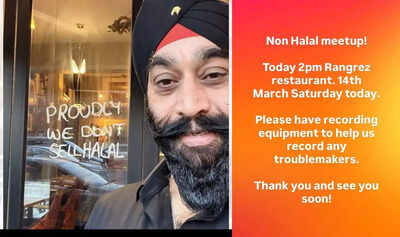

A neighbourhood Indian restaurant in west London has suddenly become the centre of a political and cultural storm stretching far beyond Hammersmith. What began as a dispute over halal and non-halal meat at a Sikh-owned establishment has spiralled into street confrontations, police intervention and viral social-media outrage.At the centre of the controversy is Rangrez, a restaurant on Fulham Palace Road that had already announced its closure after operating for 16 years. Its owner, Harman Singh Kapoor, says he faced months of harassment because the restaurant publicly refused to serve halal meat. Videos of confrontations outside the premises have since been seized upon by commentators across the world as evidence for a familiar claim in right-wing circles: that Britain has “fallen to Islam”.
What is the controversy?
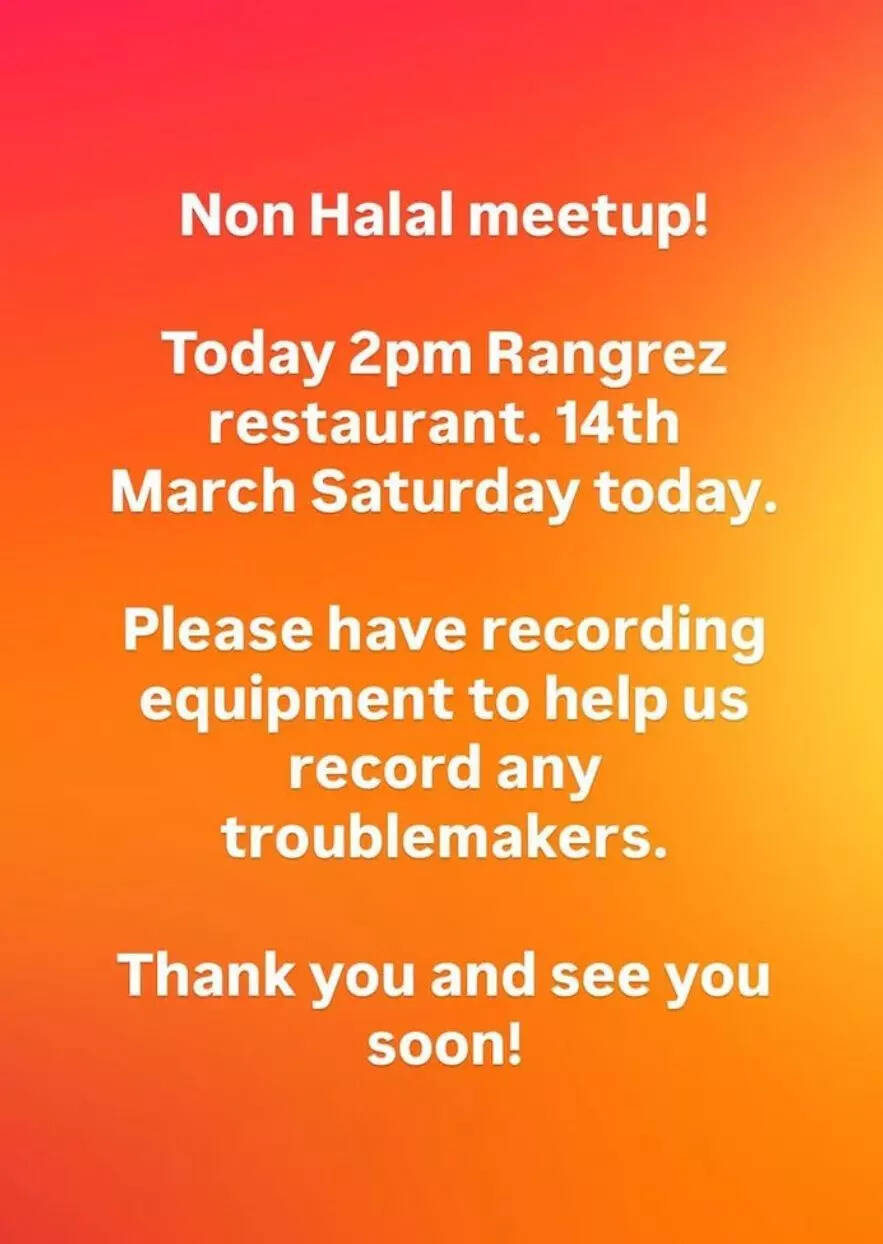
The immediate trigger was the restaurant’s declaration that it did not serve halal meat. Kapoor said that as a Sikh he preferred to serve jhatka meat, which some Sikhs consider religiously permissible in contrast to halal slaughter.According to Kapoor, the decision led to months of harassment including fake online reviews, threats and confrontations outside the restaurant. The situation escalated on March 14, when a crowd gathered outside Rangrez. Social media posts claimed that more than a hundred people had surrounded the premises and blocked entrances while chanting slogans.In the hours leading up to the confrontation, Kapoor also promoted what he called a “Non Halal meetup” at the restaurant through his social-media accounts. The post invited supporters to gather at Rangrez at 2 pm on March 14 and asked attendees to bring recording equipment to document any “troublemakers”.The message read: “Non Halal meetup! Today 2pm Rangrez restaurant. 14th March Saturday today. Please have recording equipment to help us record any troublemakers. Thank you and see you soon!” The call for a meetup circulated widely online and drew both supporters and critics to the restaurant.Later that day Kapoor posted videos describing the situation as threatening and said he had taken his kirpan, the ceremonial blade carried by observant Sikhs, to protect his family. Hours later he was arrested while the crowd dispersed.The arrest quickly became the centre of the controversy. Supporters argue the restaurant owner was punished for defending his family and exercising his religious beliefs. Critics say the confrontation had been escalating for weeks and point to Kapoor’s own inflammatory posts.Police have not publicly clarified the circumstances of the arrest or whether charges have been filed.
Who is Kapoor?
Harman Singh Kapoor has been active for years in diaspora politics and Sikh community debates, often presenting himself as a critic of Khalistani extremism and what he describes as weak policing in Britain.He has previously said he received threats because of his activism. When he announced the closure of Rangrez earlier this year, he cited rising costs but also claimed that intimidation and disturbances around the restaurant had made it impossible to continue operating.At the same time, Kapoor’s social-media posts have attracted criticism. Some have included harsh remarks about Muslims and declarations that he would not cater to them. Those comments have complicated attempts by supporters to portray him purely as a victim of religious intolerance.How the global right turned Rangrez into a culture-war symbolOnce videos of the confrontation began circulating online, the episode was rapidly absorbed into the global culture wars.Right-wing commentators framed the incident as proof that Muslim communities were forcing businesses to comply with halal practices and that British authorities were siding with protesters rather than protecting a Sikh business owner. In this narrative, the Rangrez dispute became another example cited by critics who argue that Britain is capitulating to religious pressure.The idea that Britain has “fallen to Islam” has circulated for years across sections of the global right. Even before becoming US Vice President, JD Vance sparked controversy when he joked that Britain might become the “first truly Islamist country that will get a nuclear weapon.”Technology billionaire Elon Musk has also repeatedly criticised the British government under Keir Starmer, particularly over issues such as policing, immigration and free speech.Against that backdrop, the Rangrez episode quickly became another flashpoint. American political activist Valentina Gomez wrote on X: “Either bow… or you’ll get arrested. The UK has succumbed.” Commentator Gunther Eagleman wrote: “BRAVE Sikh restaurant owner Harman Singh Kapoor and his family are being terrorised because he refuses to sell Sharia-compliant halal meat.” Other posts claimed that Pakistanis had surrounded the restaurant and suggested the incident showed that Sharia law had effectively replaced British law. The framing mirrors the style of MAGA-aligned social-media narratives, where isolated incidents are turned into symbols of national decline. In this telling, a confrontation outside a restaurant in Hammersmith becomes evidence of a country surrendering to religious pressure.Yet many of the claims circulating online rely on partisan interpretations. The exact size of the crowd, the sequence of events leading to Kapoor’s arrest and the legal basis for police action have not yet been fully clarified.
Jhatka vs halal: what is the difference?
At the heart of the dispute lies a religious distinction rooted in South Asian traditions.Halal, in Islamic practice, refers to food permitted under Islamic law. When it comes to meat, halal slaughter requires a method known as dhabihah, in which the animal’s throat is cut while invoking the name of God and the blood is drained from the body.For Muslims, halal meat forms part of a broader framework of religious observance governing everyday life.Jhatka, by contrast, refers to a method in which the animal is killed instantly with a single blow. The term literally means “a swift strike”.The distinction has historical roots in Sikh tradition. Sikh teachings discourage consumption of kutha meat, which many Sikhs interpret as referring to meat slaughtered through ritual methods such as halal. The rejection of ritual slaughter is linked to Sikh ideas of autonomy and resistance to religious authority imposed by others.
The Empire strikes back
The Rangrez episode is about far more than a restaurant menu. It sits at the crossroads of diaspora politics, Britain’s anxieties about immigration and multiculturalism, and the modern culture wars that now travel across the internet at the speed of outrage.At one level, it reflects how South Asia’s unresolved history continues to echo inside Britain itself. The United Kingdom today hosts large communities from India, Pakistan and Bangladesh, many of whose families arrived in the decades after the Second World War. With them came memories, loyalties and grievances forged during the final years of British rule on the subcontinent.That history matters. The hurried partition of India in 1947, engineered under the departing British Empire, divided the subcontinent into India and Pakistan and hardened religious identities across the region. The trauma of that moment shaped the politics of Hindus, Muslims and Sikhs for generations.

A refugee special train at Ambala Station during the Partition of India (Source: Wiki Commons)
The British once managed those communities as subjects of empire. Today many of their descendants live in British cities. History, in other words, has completed a quiet circle.Occasionally that circle becomes visible. The Leicester riots of 2022, where Hindu and Muslim groups clashed after an India–Pakistan cricket match, were a reminder that South Asia’s rivalries can reappear thousands of miles from where they began. Social media mobilisation and diaspora politics turned a sporting dispute into a street confrontation.The Rangrez episode sits in the same uneasy landscape.It also unfolds at a moment when parts of British society are increasingly sceptical about the state’s willingness to confront Islamist extremism. Critics frequently point to the grooming gang scandals in towns such as Rotherham and Rochdale, where investigations later concluded that authorities were slow to act against organised abuse networks partly out of fear of being accused of racism.Those episodes have fed a broader sentiment among sections of the public that the British state has become overly cautious in confronting certain forms of extremism. Whether that perception is fair or exaggerated remains fiercely contested, but it has become a powerful political narrative.Right-wing commentators have seized on incidents like Rangrez to reinforce that argument. In their telling, a dispute over halal meat is not just a restaurant controversy but another sign that Britain’s institutions are unwilling to challenge religious pressure.Social media has amplified that interpretation. In the digital age, a confrontation outside a neighbourhood restaurant can become a global ideological symbol within hours. What begins as a local dispute quickly turns into a morality play about civilisation, immigration and national identity.And there is an irony running through all of this. The communal politics that intensified under the British Empire in South Asia were once exported from London to the subcontinent. Today, through migration and diaspora networks, those same tensions occasionally travel back the other way.When that happens — as in Leicester, or outside a restaurant in Hammersmith — it can feel as though the old imperial story has come full circle.The empire divided the subcontinent. Decades later, fragments of those divisions sometimes reappear on British streets — a reminder that history has a long memory, and that the past rarely stays where it began.