









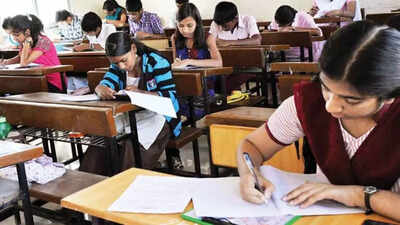
The CBSE Class 12 Chemistry examination was conducted today across the country in a single shift from 10:30 AM to 1:30 PM. The exam was held at designated centres under standard board guidelines, with students given the prescribed reading time before the three-hour paper. A total of 18,59,551 students are registered for the Class 12 board examinations this year across 120 subjects at 7,574 centres. Chemistry is a key subject for science stream students and is considered important for higher education in engineering, medical, and pure science courses.
Students report easy paper, Physical Chemistry more time-consuming
Students who appeared for the examination at Sarvodaya Kanya Vidyalaya (SKV), Khajoori Khas, Delhi, described the paper as largely easy and based on NCERT concepts, though some said numerical questions required additional time.Nida said, “The paper was easy and most of the questions were direct from NCERT. However, the Physical Chemistry section was time-consuming because of the numericals.” Tanisha Verma, who attempted Set 2, said, “Overall, the paper was easy, but some questions from Physical Chemistry needed careful calculation and took more time.” Aanchal, who appeared for Set 3, also described the exam as manageable. “The paper was easy and based on familiar concepts from the syllabus,” she said. Another student from the same centre added, “The paper was moderate overall, and the Physical Chemistry part was slightly difficult compared to the rest.”Khushi Kumawat, a Class 12 student of Witty International School, Udaipur, said, “The paper was moderate but slightly tricky in some sections. Most questions were from NCERT, but assertion–reason and numerical problems required strong conceptual understanding. Organic Chemistry was easier with direct reactions, while Inorganic Chemistry was mostly theory-based. Physical Chemistry had a few tough and time-consuming numericals. Overall, it was a balanced paper that tested both concepts and application.” Students from Seth Anandram Jaipuria School, Ghaziabad, shared a similar experience. Kushagra Tripathi and Kartik Srivastava said, “The paper was of moderate difficulty level. It was time-taking, especially while solving numericals in Section C. Some organic conversion questions were slightly difficult, but we were able to complete the paper within the allotted time.” Students said the paper covered topics from Physical, Organic, and Inorganic Chemistry, with internal choices provided across sections. Numerical questions required careful use of formulas, units, and significant figures.
Teachers say paper was balanced, NCERT-based and concept-focused
Seema Chaturvedi, PGT Chemistry, B-2 Yamuna Vihar, Delhi, said the question paper was simple, balanced and closely aligned with the prescribed syllabus. “The paper was good and well balanced. Overall, it was much easier for students who had prepared from the NCERT textbook, as the questions were completely based on NCERT. Most of the questions were direct, and students with clear concepts and thorough textbook preparation would have found the paper comfortable and scoring,” she said.Dr. Afjal Hussain Mazumder, PGT Chemistry, Modern English School, Kahilipara, Guwahati, said, “The Chemistry (043) question paper was NCERT-based and well balanced between numerical, knowledge, understanding, application, and higher-order thinking skills. The questions focused on critical thinking rather than shortcuts. The language was simple and largely free from unnecessary complexity. Students who studied NCERT thoroughly would benefit, while surface learners might find some questions challenging, though passing should not be difficult.” Sonam Chauhan, PGT Chemistry at Jain International Residential School (JIRS), Bengaluru, described the paper as moderate in difficulty and focused on conceptual clarity rather than memorisation. “The paper was well balanced and tested conceptual understanding. Section A (MCQs) was mostly NCERT-based and straightforward, though a few questions required careful reading. Section B demanded stronger conceptual clarity, particularly from Electrochemistry, Chemical Kinetics, and Coordination Compounds, where a logical, step-by-step approach was necessary,” she said. She added that the long-answer section gave importance to Organic Chemistry conversions, reaction mechanisms, and named reactions, while numerical questions were direct and formula-based. “Physical Chemistry included moderate-level numericals that were largely formula-driven. Organic Chemistry was slightly tricky but fully NCERT-based, while Inorganic Chemistry was predictable for students who had studied the textbook thoroughly.” According to her, time management played an important role. “The paper could be completed within the allotted time, but some numericals and reasoning-based questions required careful calculation and explanation. Overall, the paper was fair, student-friendly, and aligned with the CBSE examination pattern.”Somya Hooda from the Chemistry Department at Silverline Prestige School said, “The paper included a good mix of competency-based and moderate questions that assessed application of knowledge. Most questions were based on CBSE sample papers. Direct questions were straightforward, and the MCQs and competency-based questions were of average difficulty. Students finished the paper on time and were satisfied. Overall, all sets were moderate to easy.” Jyoti Samant, Educator (Senior Years), Shiv Nadar School, Gurgaon, said the paper was closely aligned with the curriculum. “Most questions were drawn directly from NCERT, and many students found the paper easy overall. However, scoring full marks required detailed conceptual understanding. Numerical and conversion-based questions tested application skills and accuracy, making the paper a fair assessment.” Sarita Khokhar, Academic Coordinator and HOD Science at Seth Anandram Jaipuria School, Ghaziabad, said, “The overall difficulty level was moderate. While most questions were NCERT-based, some required conceptual clarity, especially numericals and organic conversions. The paper followed the CBSE blueprint and provided a balanced mix of understanding, application, and memory-based questions.” Komal Rishi, PGT Chemistry, Global Indian International School, Noida, noted that the paper strictly followed the CBSE pattern. “All questions were NCERT-based and familiar to students. The difficulty level was well balanced, and students completed the paper comfortably. Most were satisfied as several questions were based on PYQs.” Ravi Verma, PGT Chemistry, Witty International School, Udaipur, said, “The paper was of moderate difficulty and well balanced. MCQs were straightforward, though assertion–reason questions were relatively tricky. Organic Chemistry was easier, Physical Chemistry included some challenging numericals, and Inorganic Chemistry was largely direct.” Principal Dr. Alka Kapur of Modern Public School, Shalimar Bagh, said, “The paper was easy to moderate and NCERT-based. While many questions were direct, an in-depth study of the textbook and regular practice were necessary for accuracy. The overall composition was balanced, with direct, competency-based, and concept-oriented questions.”Share Your Thoughts: Students’ Reactions and Teachers’ AnalysisThis is a developing story, keep visiting for the latest updates. We also want to hear from you! If you are a student, share your reaction to the question paper, or if you are a teacher, provide your analysis. You can do so by leaving a comment on this article as a readers’ opinion. Selected comments will be featured in the article.